

The ideas aroused within me by ruins are lofty. Everything vanishes, everything perishes, everything passes away, the world alone remains, time alone continues.
At the Paris Salon of 1767, two years after returning from Rome, Hubert Robert presented thirteen easel paintings across several subjects, including views of ruins and actual or imagined architecture, landscapes and picturesque scenes. Denis Diderot’s account of the exhibition, written for Friedrich Melchior Grimm’s Correspondance littéraire and circulated in manuscript, is among the earliest discussions of Robert’s work. Diderot moved between close criticism and an argument about the genre itself, objecting to the number of figures in one composition because they disrupted the solitude he associated with ruins, then asking where the peoples who built the monuments had gone and what their remains disclosed about time. His Salon records both the reception of Robert’s paintings and an attempt to define the demands of painting ruins.
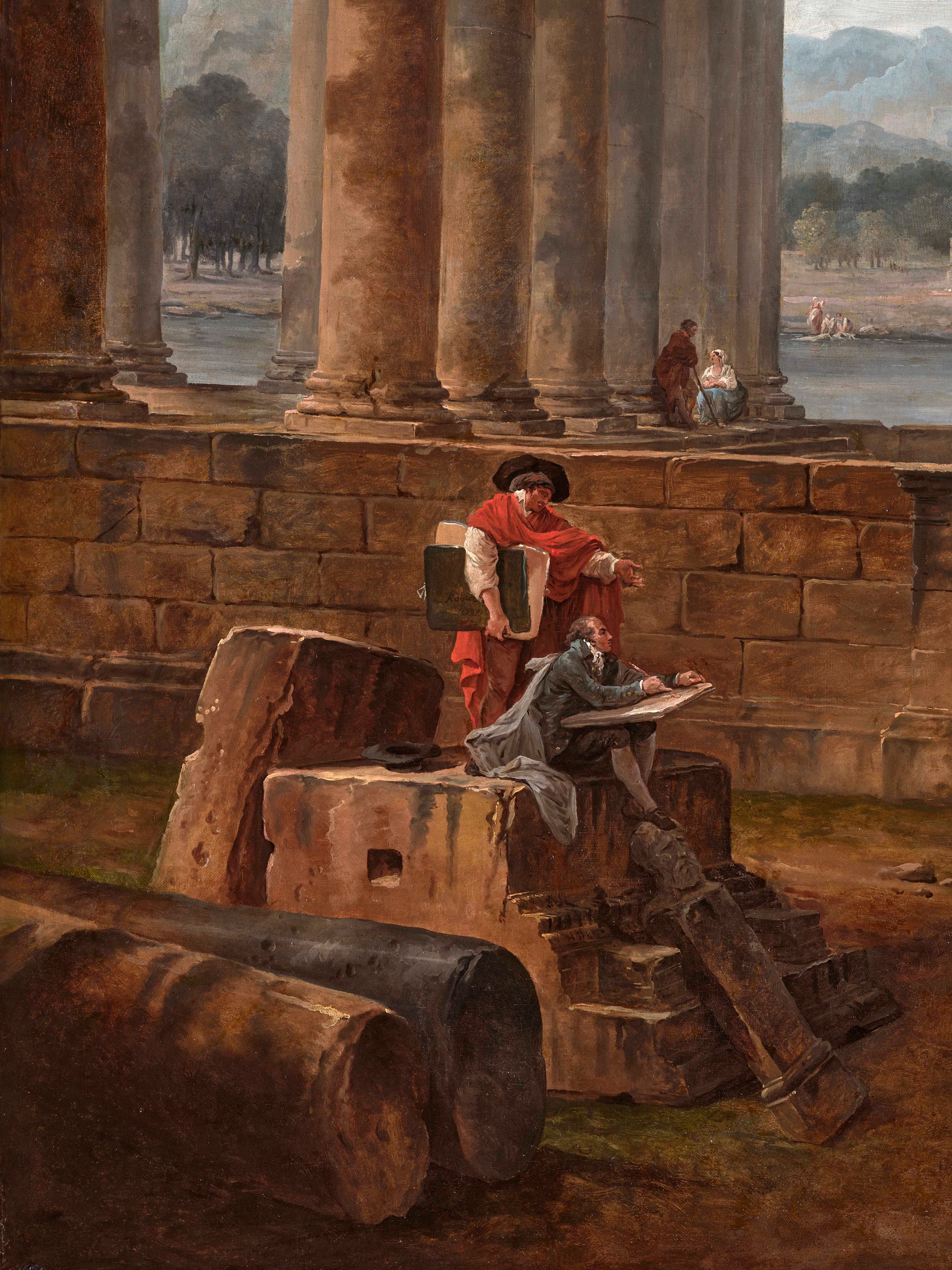
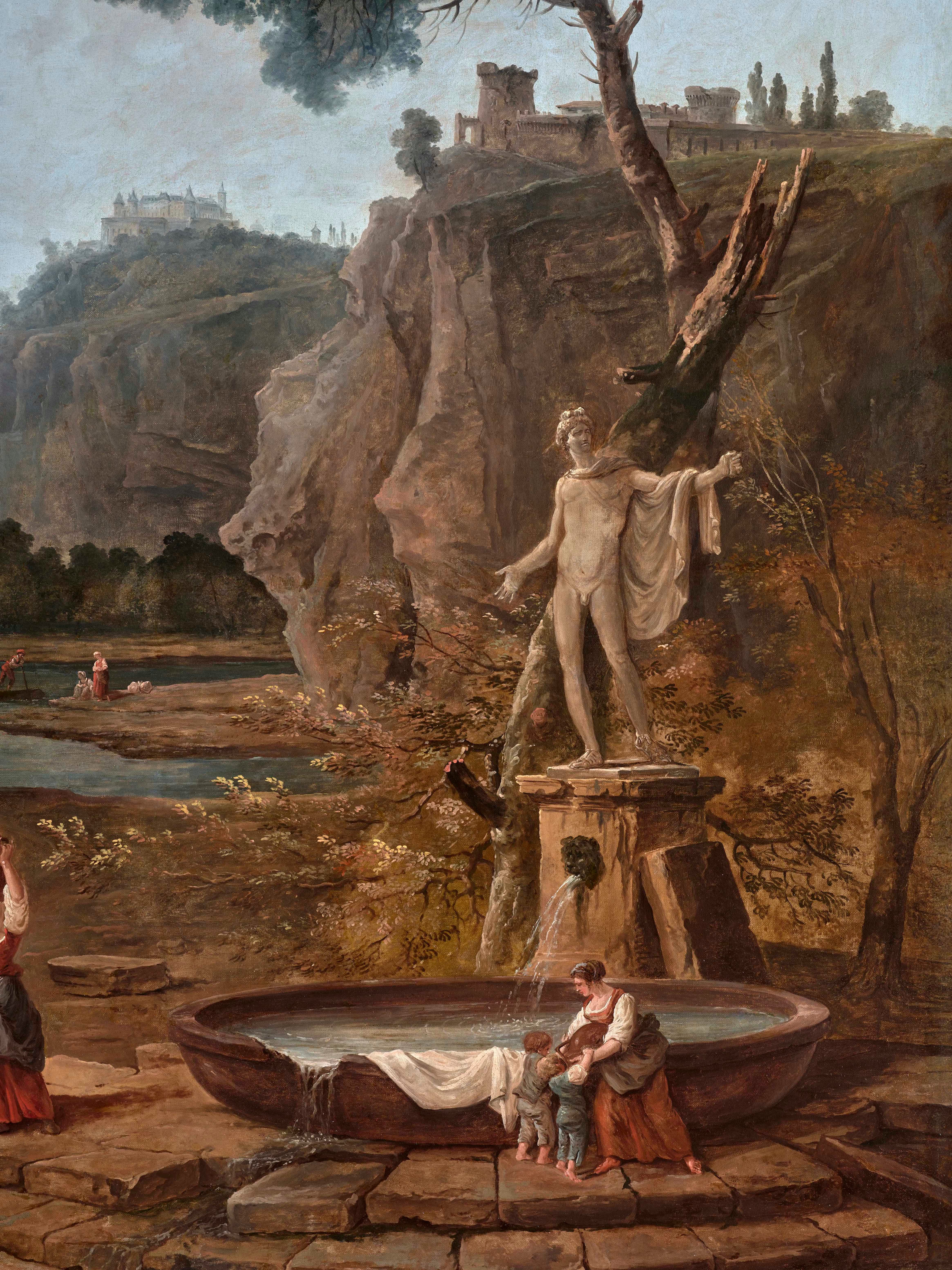
Details of Hubert Robert (Paris, 1733–1808), A capriccio featuring ancient ruins, a fountain in the foreground, and a self-portrait of the artist at work, 1797; signed and dated Robert / 1797 on the board held by the figure in red, lower left; oil on canvas, 242 × 242 cm (95¼ × 95¼ in.).
Robert’s approach had taken shape during eleven years in Italy, where he arrived in 1754 in the entourage of the French ambassador Étienne François, comte de Stainville, later duc de Choiseul, studied at the Académie de France in Rome with Giovanni Paolo Panini, and sought advice from the printmaker Giovanni Battista Piranesi. From these experiences he developed a practice that joined close study of ancient architecture to invented compositions, bringing him immediate success on his return to Paris and admission to the Académie Royale in 1766. The two canvases signed and dated 1797 belong to this mature phase, but were made after Robert’s imprisonment during the Revolution and his reinstatement under the Directory as a curator at the Louvre. Their imagined settings draw on motifs he had studied in Italy, including a fountain figure reminiscent of the Apollo Belvedere, and one contains a rare probable self-portrait of Robert sketching outdoors.
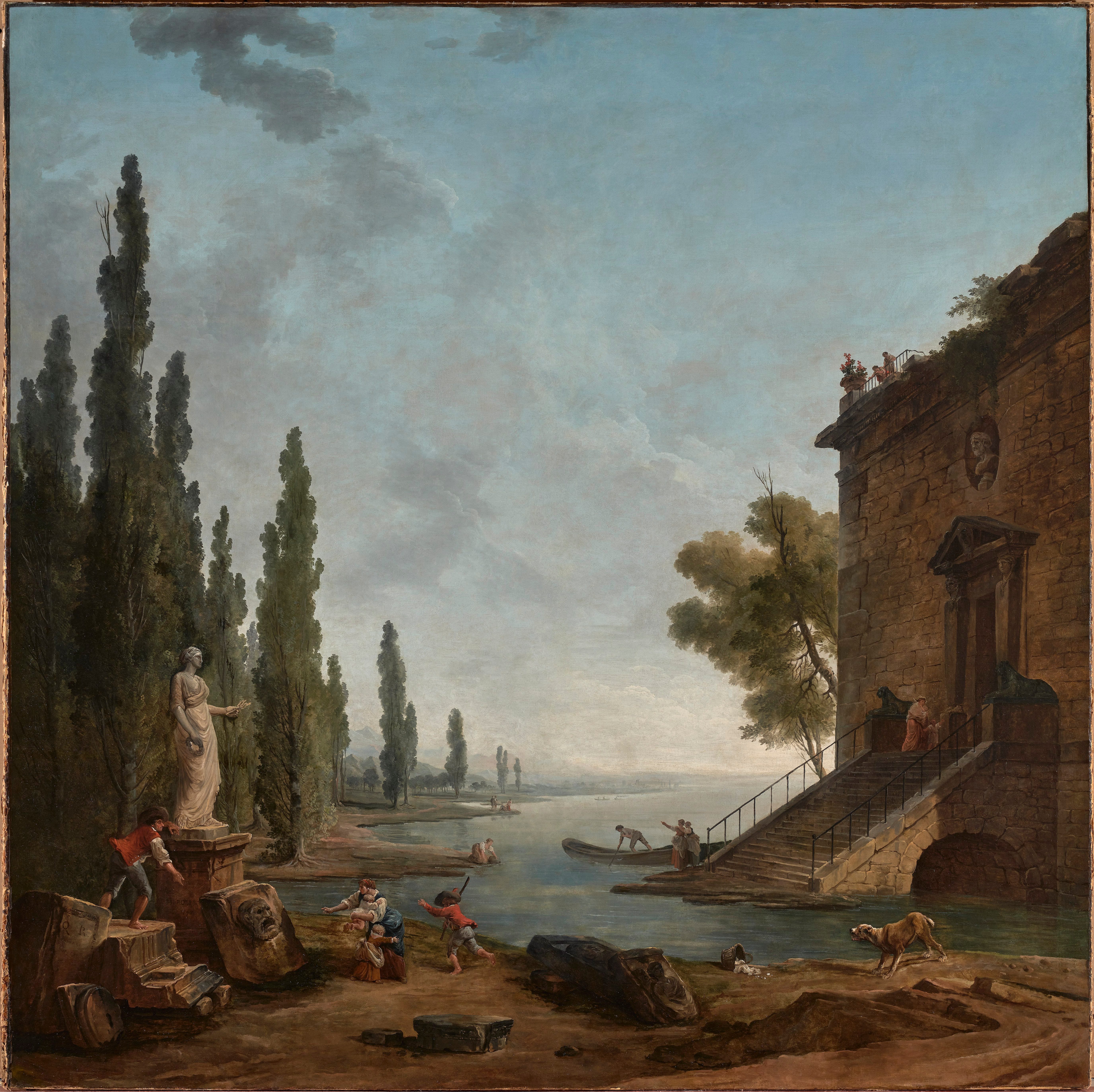
Hubert Robert (Paris, 1733–1808), A capriccio of a villa surrounded by a moat, with a classical statue of a goddess to the left, 1797; signed and dated H. Robert / 1797 on the statue’s plinth, lower left; oil on canvas, 242 × 242 cm (95¼ × 95¼ in.).
The paintings are equal in scale, each measuring 242 centimetres square, and both remain on their original stretchers. In the first, a villa stands within a moat, with a classical statue of a goddess positioned to one side. The architecture and sculpture have the authority of studied forms, but the objects cannot be identified as copies of particular surviving monuments. Robert’s knowledge of ancient remains is evident in their treatment, yet he has not set out to record a single archaeological site. The villa and its surroundings belong instead to the capriccio, a form in which observed architectural elements could be recombined to create a place that was coherent in its details but did not correspond to a known location.
The second canvas brings the relationship between observation and invention into closer focus. Ancient ruins and a fountain occupy the foreground, while a fortified town rises in the distance. The sculpture above the fountain recalls the Apollo Belvedere, the celebrated ancient statue that Robert also used in other compositions. The town, by contrast, evokes Tivoli through its elevated position, but its rounded turrets and sloping roofs belong more closely to the architecture of a French Renaissance château. The composition therefore draws on Robert’s experience of Italy without simply reproducing an Italian view, combining motifs associated with different places and architectural traditions within a single imagined setting.
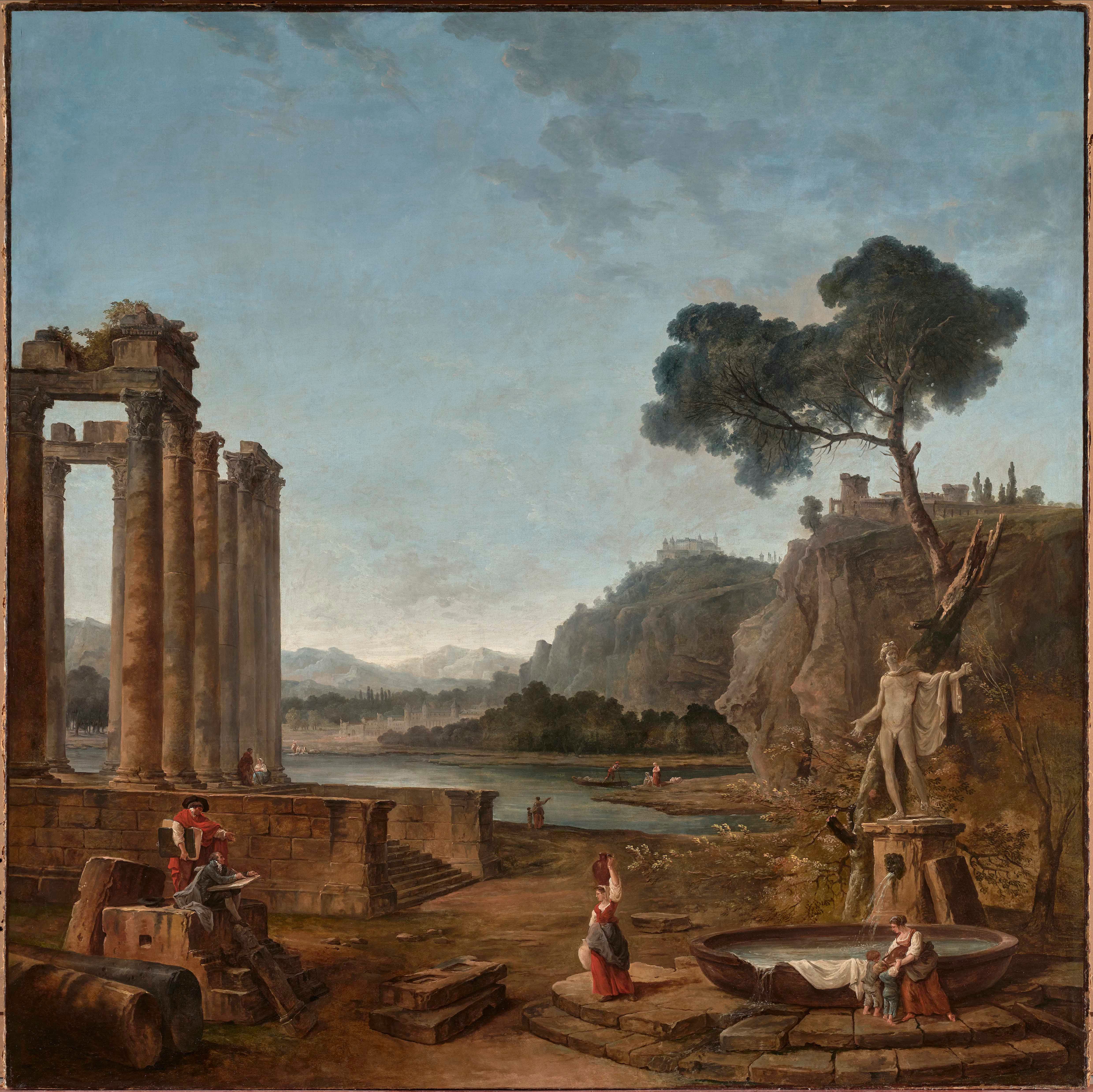
Hubert Robert (Paris, 1733–1808), A capriccio featuring ancient ruins, a fountain in the foreground, and a self-portrait of the artist at work, 1797; signed and dated Robert / 1797 on the board held by the figure in red, lower left; oil on canvas, 242 × 242 cm (95¼ × 95¼ in.).
This meeting of Italian and French forms is unusual within Robert’s body of work, where classical and contemporary architecture are more often brought together in other ways. Here the town’s northern European character sits alongside antique sculpture and Roman ruin, making visible the two strands that shaped Robert’s career, his French origins and his study of Italian architecture. The combination also recalls the conditions under which his capricci were made. Robert had encountered the buildings and sculptures of Rome directly, but his compositions were produced for a Parisian audience familiar with these monuments through travel, prints and collections, and capable of recognising their forms even when they appeared in settings that existed only in paint.
A small figure at the lower left of the second canvas appears to be Robert himself, drawing outdoors. The identification is probable. The figure’s features have been compared with contemporary portraits of the artist, while his activity corresponds with Robert’s own practice of making drawings from nature during his Italian years. Artists sketching in the landscape appear elsewhere in Robert’s work, but few can be convincingly identified as self-portraits. Another probable example appears in Landscape with a Terrace and Cascade, painted in 1802, five years after the present pair.
Robert made the date and authorship part of each composition, inscribing “H. ROBERT / 1797” on the statue’s plinth in the villa painting and “Robert / 1797” on a board held by the figure in red. The pair was painted a year after the 1796 Salon, where Robert exhibited two views of the Louvre’s Grande Galerie, one proposing its arrangement as a museum and the other showing the same space in ruins. The Louvre records these works as pendants, and scholarship has related them to the Revolution’s transformation of the former royal palace into a national museum. Read against this history, the 1797 pair may be understood as bringing Robert’s study of ancient architecture into contact with the political changes he had witnessed in France.
Old soul, young eye.
Old Masters made modern.
Colnaghi continues to celebrate the dialogue between past and present.
Visit our Website
Read our Latest Journal
Follow us on Instagram