

In A Thousand Miles up the Nile, Amelia Edwards recounts the journey through Egypt and Nubia that she undertook during the winter of 1873–74, travelling south from Cairo in a dahabiya and visiting the monuments that had become accessible to a growing number of European travellers during the nineteenth century. Published in 1877, the book is written with the immediacy of a travel narrative, yet Edwards was increasingly troubled by the destruction she encountered at archaeological sites, where antiquities were removed for private collections and monuments were damaged by visitors seeking souvenirs. Her journey ultimately led her away from fiction and towards the study of ancient Egypt: in 1882 she became one of the founders of the Egypt Exploration Fund, established to support archaeological excavation and the systematic recording of monuments that she feared would otherwise disappear.
Edwards travelled through an Egypt already transformed by more than half a century of European archaeological and artistic activity. Napoleon’s expedition of 1798 had been followed by the publication of the Description de l’Égypte, the decipherment of hieroglyphs by Jean-François Champollion and the formation of major Egyptian collections in Paris, London and Turin. By the time the Suez Canal opened in 1869, the journey along the Nile had become part of an established culture of travel in which archaeological scholarship existed beside tourism, and the monuments of ancient Egypt were encountered through guidebooks and images long before they were seen in person.
The works brought together in Out of the Sand: Ancient Egypt Rediscovered, now open at Colnaghi London, belong to different moments within that history. An ushabti made for an Egyptian official during the sixth century BC preserves the religious purpose for which such objects were placed in tombs, while Maxime Du Camp’s photographically illustrated account of his journey records the emergence of the camera as an archaeological instrument. Paintings by Carl Werner, Ludwig Hans Fischer and Hermann Corrodi belong to the subsequent expansion of European travel through Egypt, when artists worked from direct observation but continued to interpret the country through the conventions in which they had been trained.
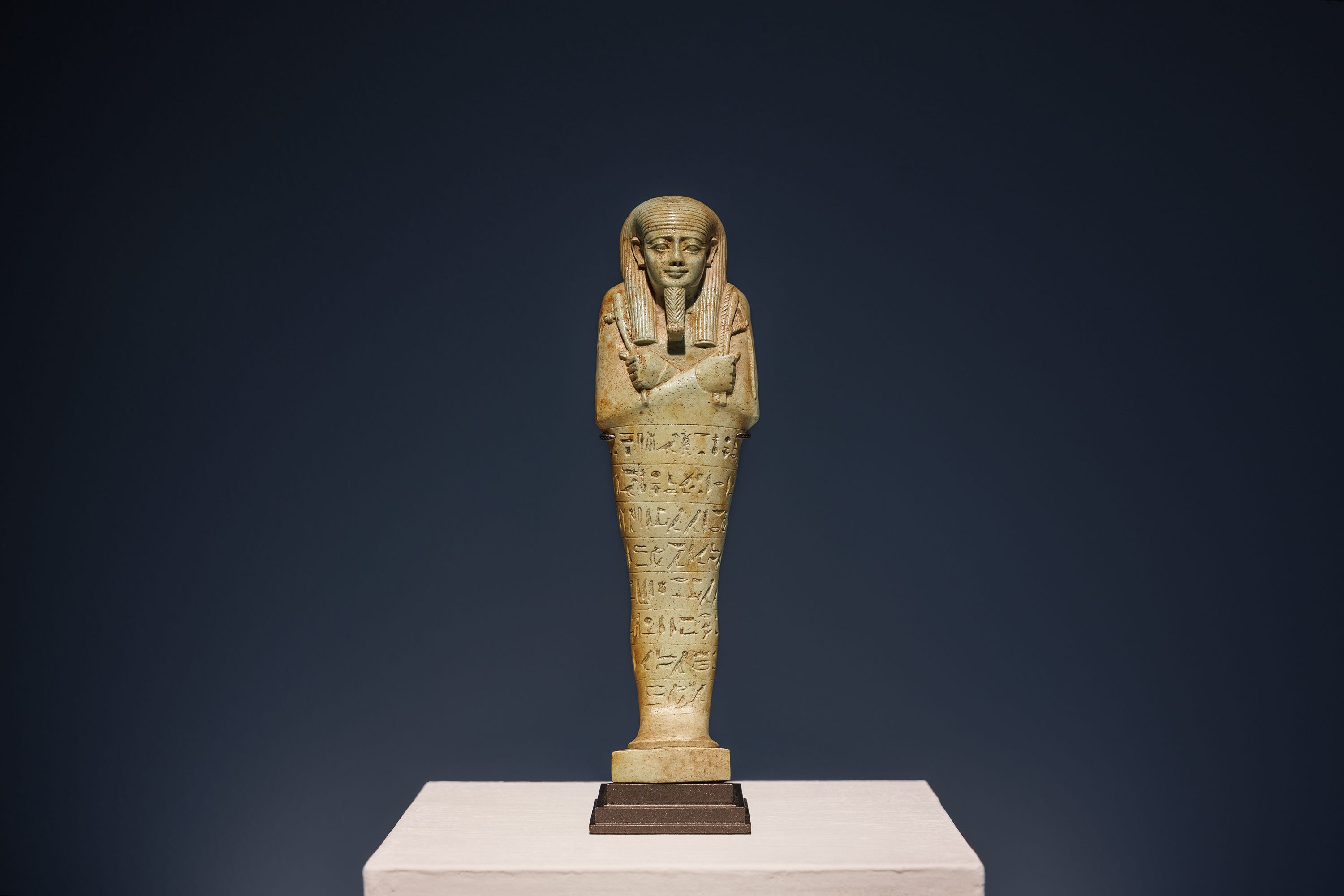
Ushabti of Neferibresaneith, Egyptian, Late Period, Twenty-sixth Dynasty, reign of Amasis II, c. 570–526 BC, green faience, 19.1 × 5.3 cm (7 ½ × 2 ⅛ in.).
The earliest of these objects was made for Neferibresaneith, an official who served during the reign of Amasis II, between approximately 570 and 526 BC, in the closing decades of the Twenty-Sixth Dynasty. Inscriptions from his tomb identify him as a wab-priest, or priest responsible for maintaining ritual purity, as well as Royal Chancellor of Lower Egypt and Administrator of the Palace, titles that placed him within the governing and religious elite of Saite Egypt. The period in which he lived was marked by the renewed political strength of an Egyptian dynasty based at Sais in the western Nile Delta, whose rulers consciously revived the artistic forms of earlier periods while maintaining extensive commercial and diplomatic relations with the Mediterranean world.
Neferibresaneith’s ushabti was one of a substantial group placed in his tomb at Saqqara, south of the pyramid of King Userkaf. Ushabtis developed from funerary figures introduced during the Middle Kingdom and were intended to undertake work demanded of the deceased in the afterlife. The agricultural implements held against the body and the seed bag carried at the shoulder identify the labour for which the figure was prepared, while the hieroglyphic inscription records a version of Chapter 6 of the Book of the Dead, the spell commanding the ushabti to answer when its owner was called upon to cultivate fields, irrigate the riverbanks or transport sand. Its concluding declaration, usually translated as “Here I am”, gave the figure its ritual agency. This was a substitute capable of acting in his name.
The survival of the figure is closely connected with the twentieth-century history of Egyptian archaeology. Cecil Mallaby Firth discovered Neferibresaneith’s tomb in 1929 and recorded 336 faience ushabtis, despite the burial having been robbed in antiquity. The group was later dispersed through the Egyptian Antiquities Service, whose official sale room at the Egyptian Museum in Cairo provided one of the recognised means by which excavated objects could enter private and institutional collections. The present example was acquired from the Cairo Museum in 1931 or 1932 by the Swiss chemist Dr Hans Eduard Fierz-David and passed by descent to his grandson Andreas Fierz. Its recorded origin distinguishes it from the many Egyptian antiquities whose archaeological contexts were lost during the nineteenth and early twentieth centuries.
The figure belongs to a particularly accomplished group of Saite ushabtis, several moulds having been used in their production before the individual features and inscriptions were finished by hand. A closely related example, acquired by the J. Paul Getty Museum in 2016, comes from the same funerary ensemble, although differences in the proportions of the face show that the surviving figures were not mechanically identical. Their pale green faience and precisely incised inscriptions exemplify the technical refinement achieved by Egyptian craftsmen during the Twenty-Sixth Dynasty.
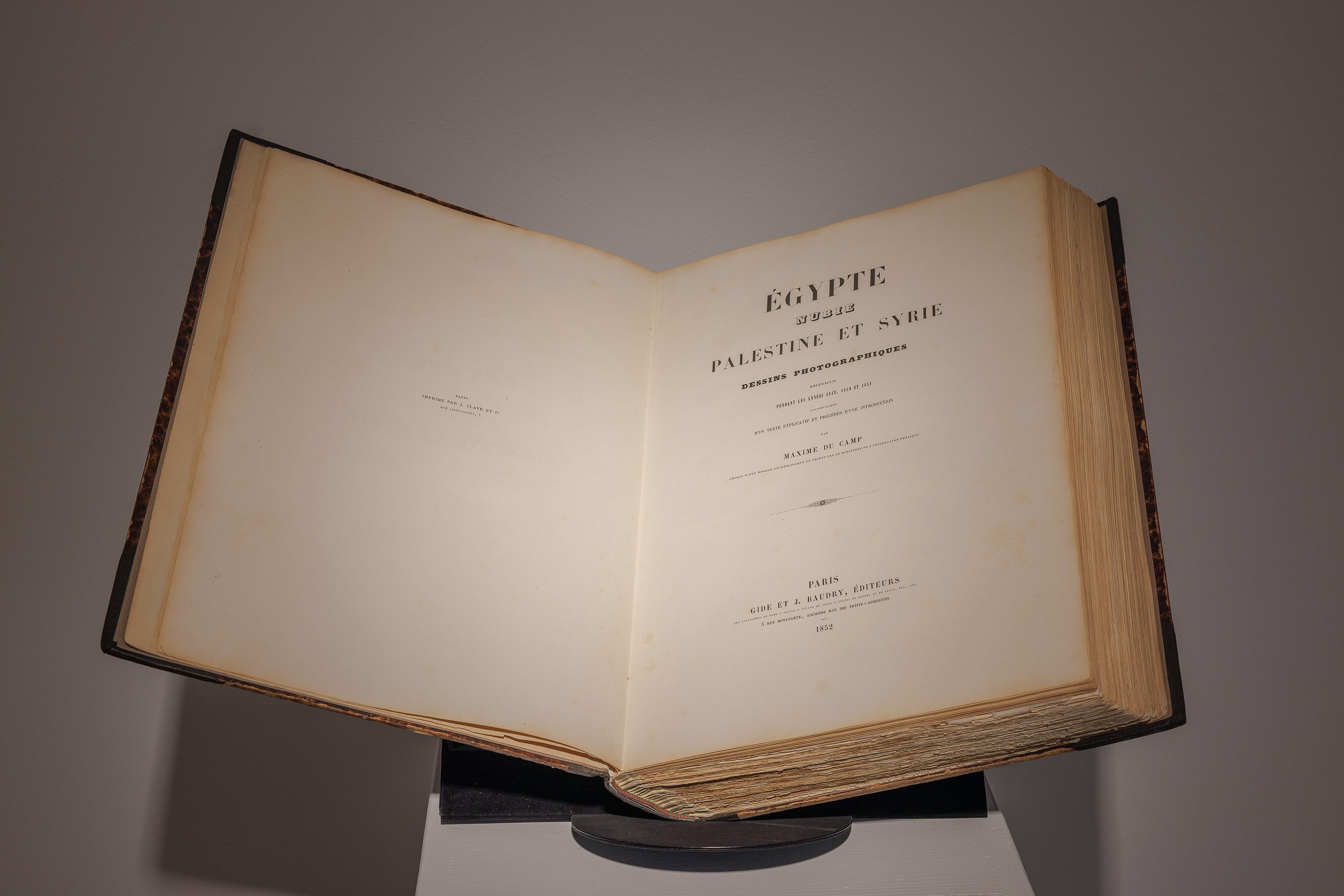
Maxime Du Camp (Paris 1822–1894 Baden-Baden), Égypte, Nubie, Palestine et Syrie: dessins photographiques recueillis pendant les années 1849, 1850 et 1851, Paris, Gide et J. Baudry, 1852, 125 salted-paper photographs mounted on paper.
More than two thousand years later, Maxime Du Camp arrived in the country with Gustave Flaubert in 1849, having obtained an archaeological mission from the French Ministry of Public Instruction and received instruction in photography from Gustave Le Gray shortly before his departure. The two men travelled south from Cairo to the Second Cataract and returned slowly along the Nile, examining the principal archaeological sites before leaving Egypt for Palestine in July 1850.
Photography had been publicly announced only a decade earlier, and its use outside the very controlled conditions of a studio remained technically demanding. Du Camp transported his camera and chemical equipment along the Nile, preparing paper negatives and processing them close to the places he photographed. He returned with more than two hundred negatives, from which 125 images were selected for Égypte, Nubie, Palestine et Syrie, published in Paris in 1852. The prints were produced at the Lille establishment of Louis-Désiré Blanquart-Evrard, whose methods made it possible to manufacture photographic images in sufficient quantities for publication.
The importance of Du Camp’s book lies partly in its physical construction. Each of its 125 salt prints was produced photographically and mounted onto the page, accompanied by a printed caption and protected by a tissue guard. The volume also included plans of Karnak, Medinet Habu and Philae, reinforcing the official archaeological purpose of the expedition. Unlike earlier publications in which an artist’s drawing passed through the interpretative hand of a lithographer or engraver, Du Camp’s book contained images created by the direct action of light upon a sensitised surface, giving photography a claim to documentary authority that would prove decisive for the future study of architecture and archaeology.
Du Camp selected the position of his camera and frequently used human figures to indicate the scale of the monuments; in some negatives he also altered the sky to clarify the outline of the architecture. The apparent objectivity of the photograph therefore depended upon a series of technical and compositional decisions, although the precision with which it recorded inscriptions and architectural details offered scholars a body of evidence fundamentally different from the picturesque conventions of earlier travel illustration. His publication brought him immediate recognition and became one of the foundational works of archaeological photography.
Among the monuments photographed by Du Camp was the Great Temple at Abu Simbel, constructed during the reign of Ramesses II in the thirteenth century BC near the southern frontier of the Egyptian empire. Johann Ludwig Burckhardt had identified the site in 1813, when much of its façade remained covered by sand, and Giovanni Battista Belzoni succeeded in entering the temple in 1817 after clearing its entrance. When David Roberts visited in 1838, the lower sections of the colossal seated figures of Ramesses were still buried; Du Camp’s photographs of March 1850 record the monument during the continuing process of excavation, with the relationship between exposed stone and accumulated sand still plainly visible.
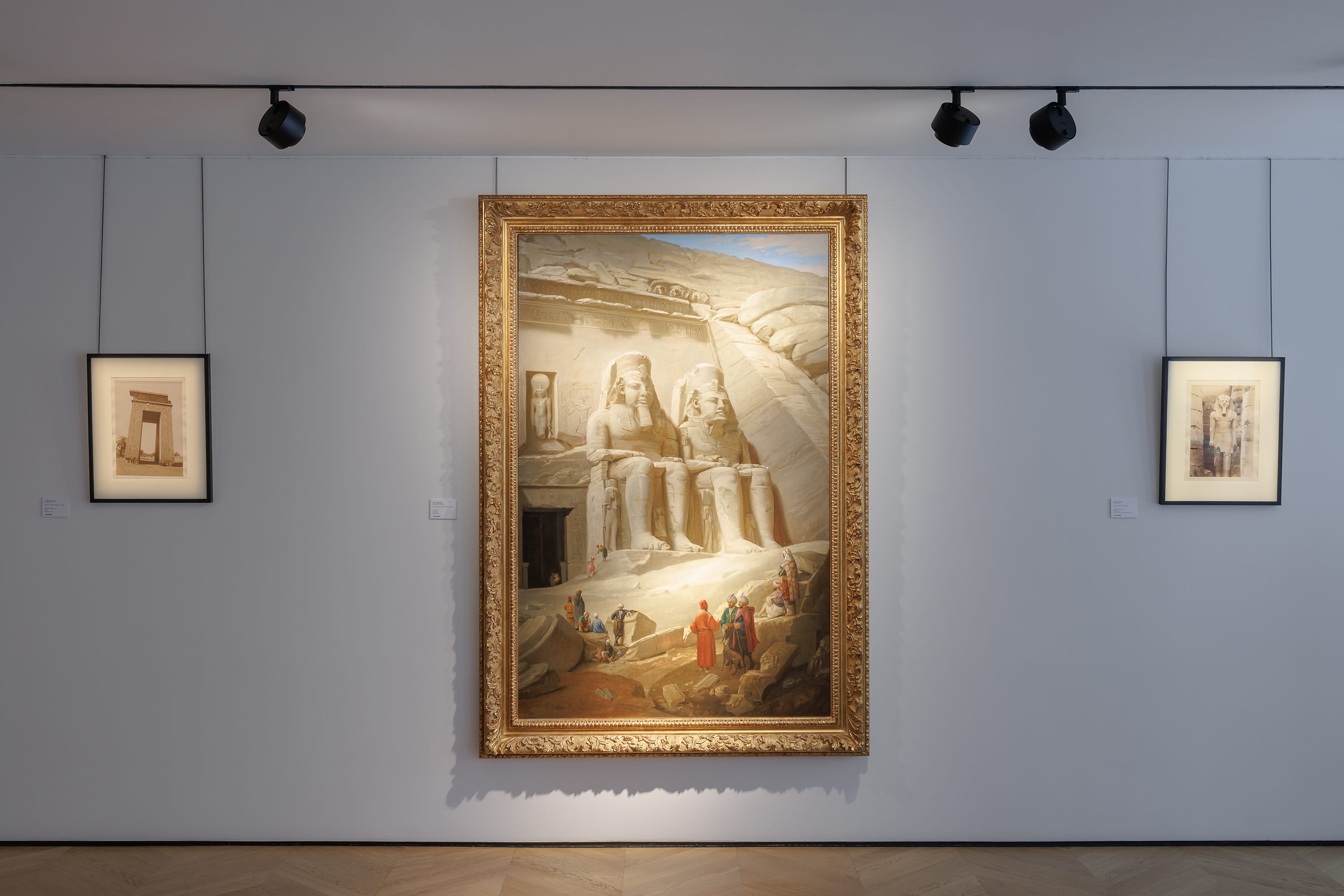
Carl Werner (Weimar 1808–1894 Leipzig), At the Temple of Abu Simbel, c. 1860, signed lower left “Carl. Werner. f”, oil on canvas, 190 × 122 cm (74 ¾ × 48 in.).
Carl Werner encountered Abu Simbel after further clearance had exposed more of its façade. Born in Weimar in 1808 and trained at the Leipzig Academy, Werner received a Saxon travelling scholarship in 1832 and visited Goethe shortly before the poet’s death, when Goethe examined his portfolio and encouraged him to travel to Italy. Werner spent much of the following two decades in Rome and became the first president of the German Artists’ Association in 1835, before establishing a studio in Venice in 1851. His journeys through Spain in 1856 and 1857, including his study of the Alhambra, preceded visits to Palestine and Egypt in 1862 and a further expedition into Nubia in 1864.
At the Temple of Abu Simbel belongs to this period of travel and was almost certainly developed from Werner’s direct study of the site. His long formation in Rome had trained him to understand architecture through the example of ancient imperial monuments, and at Abu Simbel he encountered a structure in which the body of the ruler was itself incorporated into the architecture of the state. The human figures gathered below the colossal statues establish the scale of Ramesses’s project, while the restricted view of the sky concentrates attention upon the mass of the rock-cut façade. Werner’s painting was exhibited at the Royal Academy in 1877, the same year in which Edwards published A Thousand Miles up the Nile, and later appeared in Lynne Thornton’s study of eighteenth- and nineteenth-century journeys to the East and in the exhibition De Delacroix à Kandinsky: L’orientalisme en Europe.
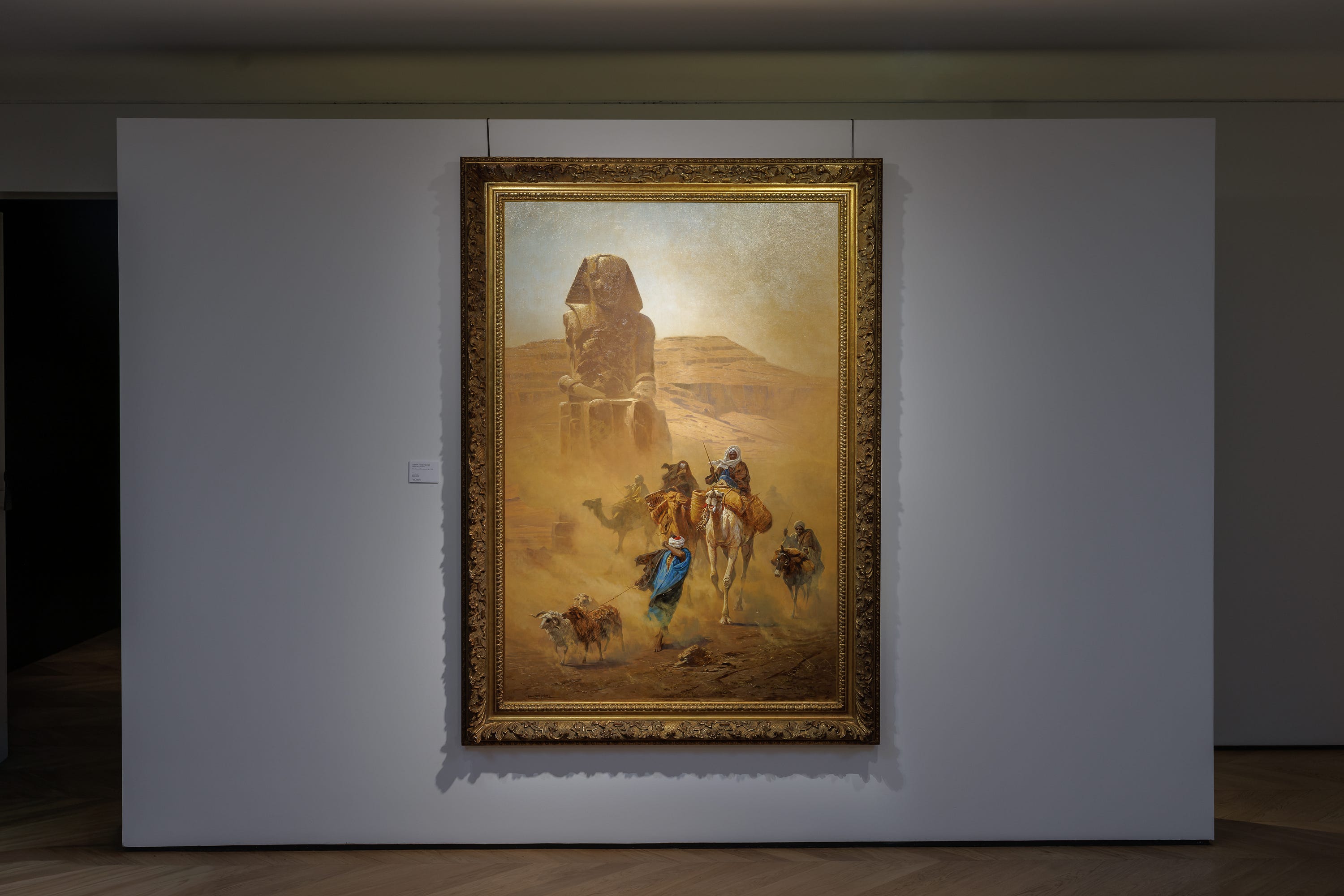
Ludwig Hans Fischer (Salzburg 1848–1915 Vienna), The Simoon, c. 1878, signed lower right, oil on canvas, 176 × 117 cm (69 ¼ × 46 ⅛ in.).
The desert is more dangerous in Ludwig Hans Fischer’s The Simoon, painted around 1878. Fischer had studied at the Vienna Academy under the landscape painter Eduard Peithner von Lichtenfels and trained in the graphic arts with Louis Jacoby and William Unger before receiving an Academy scholarship for travel in 1875. His first journey took him through North Africa and Egypt towards Palestine and Asia Minor, and the studies he produced established the basis of a career that combined painting with a serious interest in geography and ethnography. He returned repeatedly to Egypt and later became a corresponding member of the Imperial and Royal Central Commission for the Research and Preservation of Monuments.
The simoom was a hot, dust-laden wind associated in European writing with the deserts of North Africa and the Middle East, where it became a familiar image of physical disorientation and mortal danger. Fischer’s large canvas belongs to the early period of his engagement with the region, when the information gathered during travel was being translated into works intended for European exhibitions. The painting has been included in De Delacroix à Kandinsky, shown in Brussels, Munich and Marseille between 2010 and 2011.
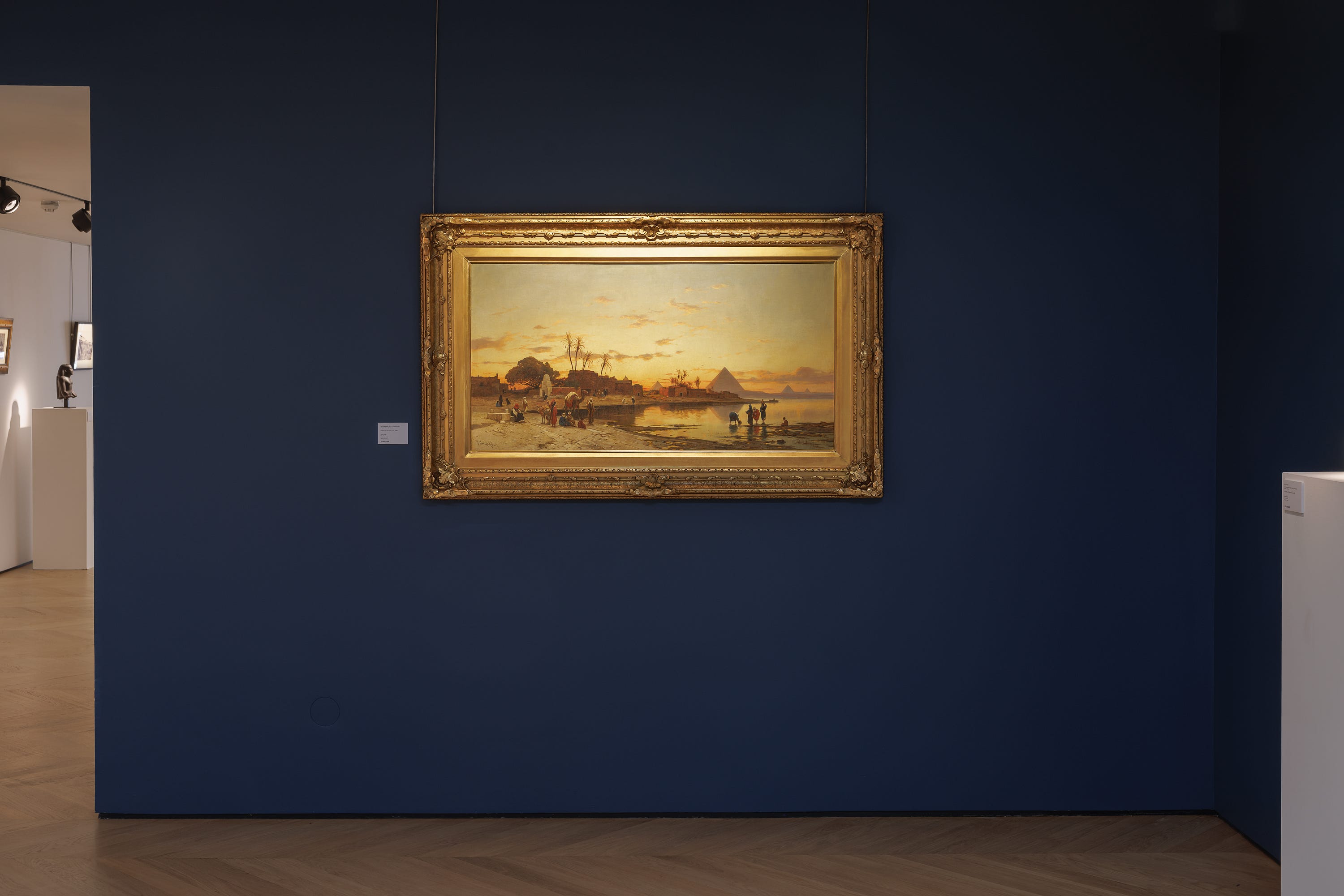
Hermann David Salomon Corrodi (Frascati 1844–1905 Rome), Sunset on the Nile, c. 1890, signed lower right “H. Corrodi Roma”, oil on canvas, 98 × 115 cm (38 ⅝ × 45 ¼ in.).
Hermann Corrodi’s Sunset on the Nile, painted around 1890, belongs to a later phase in the European representation of Egypt. Corrodi was born in Frascati in 1844 into a family of artists and studied landscape painting with Alexandre Calame in Geneva before continuing his education at the Accademia di San Luca in Rome. His encounter with the work of Jean-Léon Gérôme in Paris introduced him to the academic language through which subjects drawn from North Africa and the Middle East were being presented to European audiences. By the time of his first Egyptian journey in the winter of 1876–77, his reputation was already established: he had exhibited internationally, received a gold medal at the Vienna Universal Exhibition of 1873 and formed a friendship with Lawrence Alma-Tadema that introduced him to British patrons and the Royal Family.
Corrodi travelled repeatedly through Egypt and the eastern Mediterranean during the 1880s, returning to his Roman studio with the sketches and objects from which he developed finished paintings. Sunset on the Nile emerged from this practice of recollection and reconstruction. The pyramids belong to the distant landscape rather than dominating it, and the principal subject is the river on whose annual inundation Egyptian agriculture had depended since antiquity. Corrodi’s command of atmospheric landscape brought him commissions from Queen Victoria and Kaiser Wilhelm II; in 1893 he was appointed Accademico di Merito by the Accademia di San Luca, where he had also taught.
Explore the full exhibition online and visit Out of the Sand at Colnaghi London until 17 November 2026.
Old soul, young eye.
Old Masters made modern.
Colnaghi continues to celebrate the dialogue between past and present.
Visit our Website
Read our Latest Journal
Follow us on Instagram