

When Gustave Flaubert and Maxime Du Camp left Marseille for Egypt in 1849, they carried with them two very different means of recording the journey. Flaubert filled his notebooks, although much of what he wrote remained unpublished during his lifetime, while Du Camp worked with a camera, preparing and exposing each negative beneath the Egyptian sun. The photographs he brought back formed one of the earliest extensive photographic surveys of Egypt and helped to establish the visual conventions through which its monuments would be encountered during the remainder of the nineteenth century.
The volume produced from that journey may now be seen at Colnaghi London as part of Out of the Sand: Ancient Egypt Rediscovered. Published in Paris by Gide and J. Baudry in 1852, Du Camp’s Égypte, Nubie, Palestine et Syrie contains 125 original salt prints made from photographs taken between 1849 and 1851, accompanied by explanatory texts and engraved plans of Karnak, Medinet Habu and Philae. It belongs to the first generation of books illustrated with original photographs and established a model for the photographic survey that would be developed by the commercial studios working in Egypt during the decades that followed.
Photography in Egypt changed considerably between Du Camp’s expedition and the appearance of these later studios. During the 1850s, the difficulty of preparing negatives and transporting chemicals through heat and dust confined the practice largely to determined travellers and archaeological expeditions. By the 1870s, permanent studios in Cairo, Alexandria and Luxor were supplying photographs to scholars as well as to the increasing number of visitors whose journeys had been facilitated by steam navigation, the railway and the opening of the Suez Canal in 1869. Prints could be bought individually or assembled into albums, allowing the temples of Upper Egypt to enter libraries and private collections far beyond the Nile Valley.
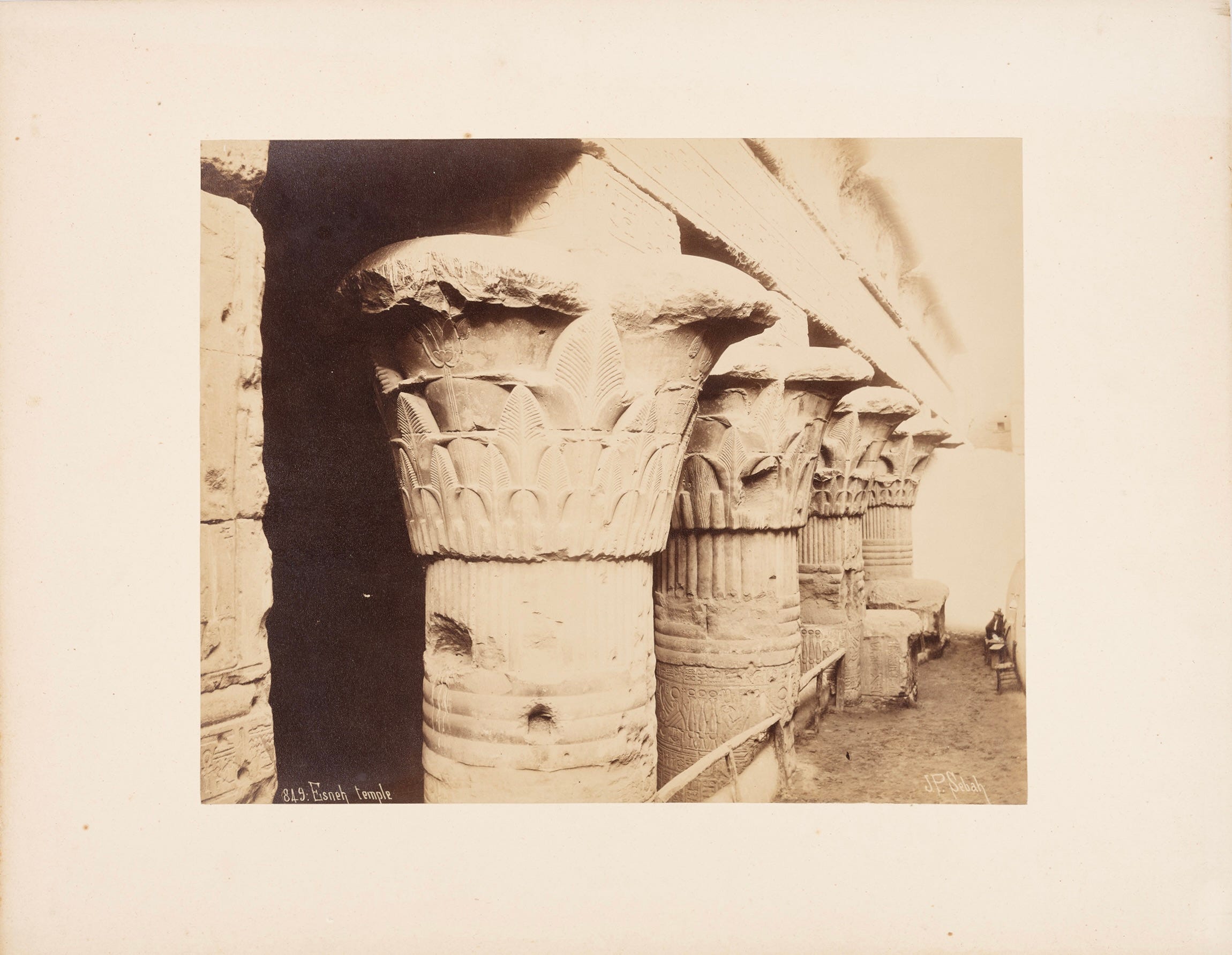
Jean Pascal Sébah (1872–1947), Temple of Esna, ca. 1870–90s. Albumen print mounted on card. (Sold unframed.)
The photograph of the Temple of Esna belongs to the extensive production of the Sébah studio, one of the most successful photographic businesses operating in the Ottoman world during the second half of the nineteenth century. Pascal Sébah opened his first studio in Constantinople in 1857 and established a branch in Cairo in 1873, producing architectural views and portraits for an international clientele. After his death in 1886, the business continued under his brother Cosmi before his son, Jean Pascal Sébah, joined Polycarpe Joaillier in the firm known as Sébah & Joaillier.
The temple at Esna was dedicated principally to Khnum, the ram-headed god associated with creation and the source of the Nile. What survived above ground in the nineteenth century was the great pronaos constructed and decorated under Roman rule, its floor lying considerably below the surrounding town as successive phases of occupation raised the level of the streets around it. The photograph belongs to a period when the temple remained closely enclosed by later buildings, before modern clearance isolated the monument from much of its urban setting. For European viewers, the print made the dense reliefs and inscriptions of Esna available for private study, although it also separated the temple from the modern town of which it had long formed a part.
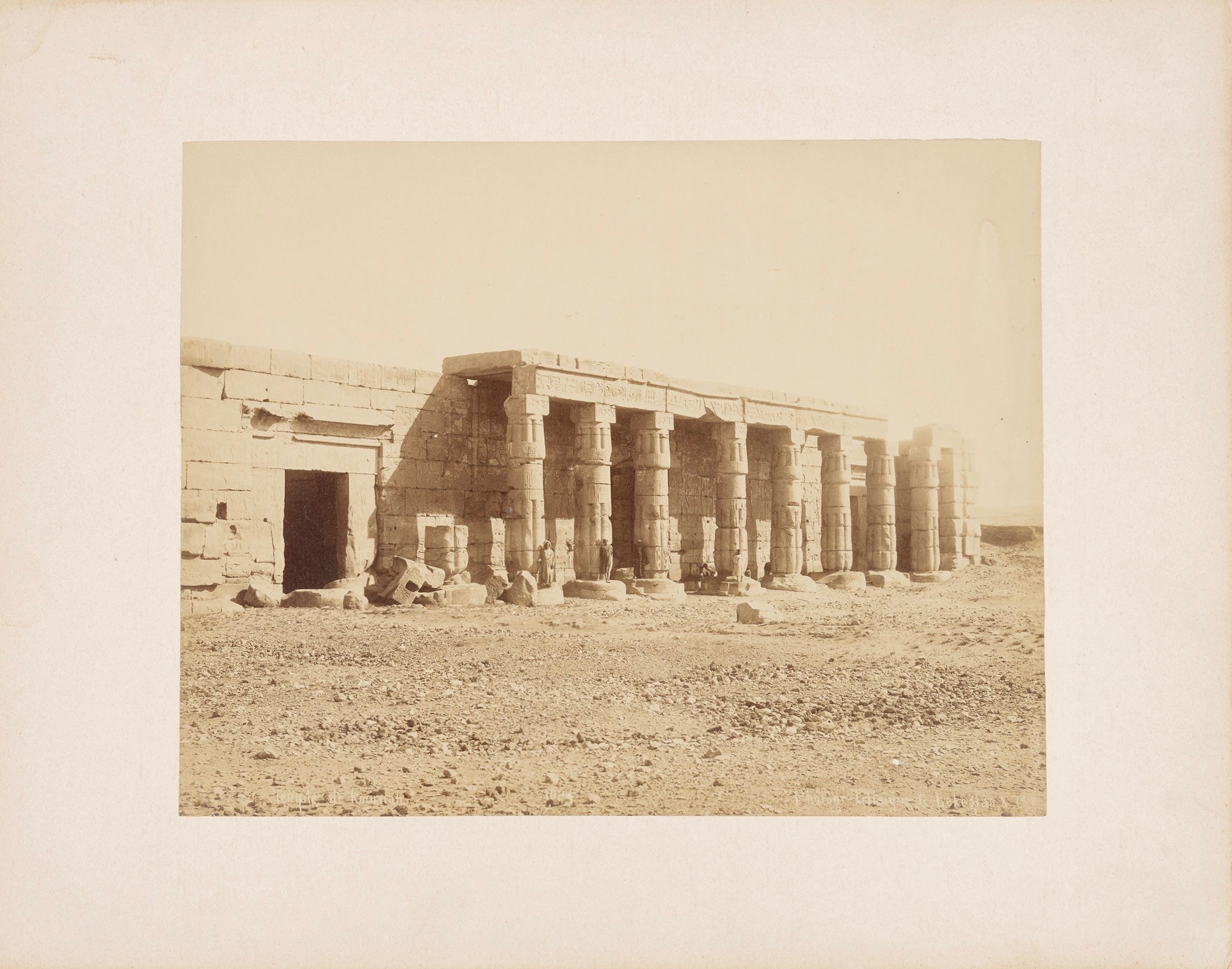
Gabriel Lekegian, Temple de Kournah / Temple of Qurna, ca. 1880–90s. Albumen print mounted on card. (Sold unframed.)
Gabriel Lekegian established his photographic business in Cairo during the 1880s and became one of the leading studio photographers working in Egypt at the end of the century. Of Armenian origin, he produced portraits and archaeological views for a clientele drawn from Egyptian society and the international community of Cairo. His studio’s technical proficiency and extensive catalogue allowed its photographs to circulate widely in albums devoted to Egypt and the Nile.
The Temple de Kournah represents the mortuary temple of Seti I at Qurna, constructed on the west bank of the Nile opposite Luxor and completed after the king’s death by Ramesses II. Dedicated to the royal cult and to Amun, the temple formed part of the extensive sacred landscape of western Thebes, where mortuary temples stood between the cultivated land and the entrances to the royal cemeteries. By the time Lekegian photographed it, the building had passed through centuries of occupation and partial burial before entering the developing archaeological record of the nineteenth century.
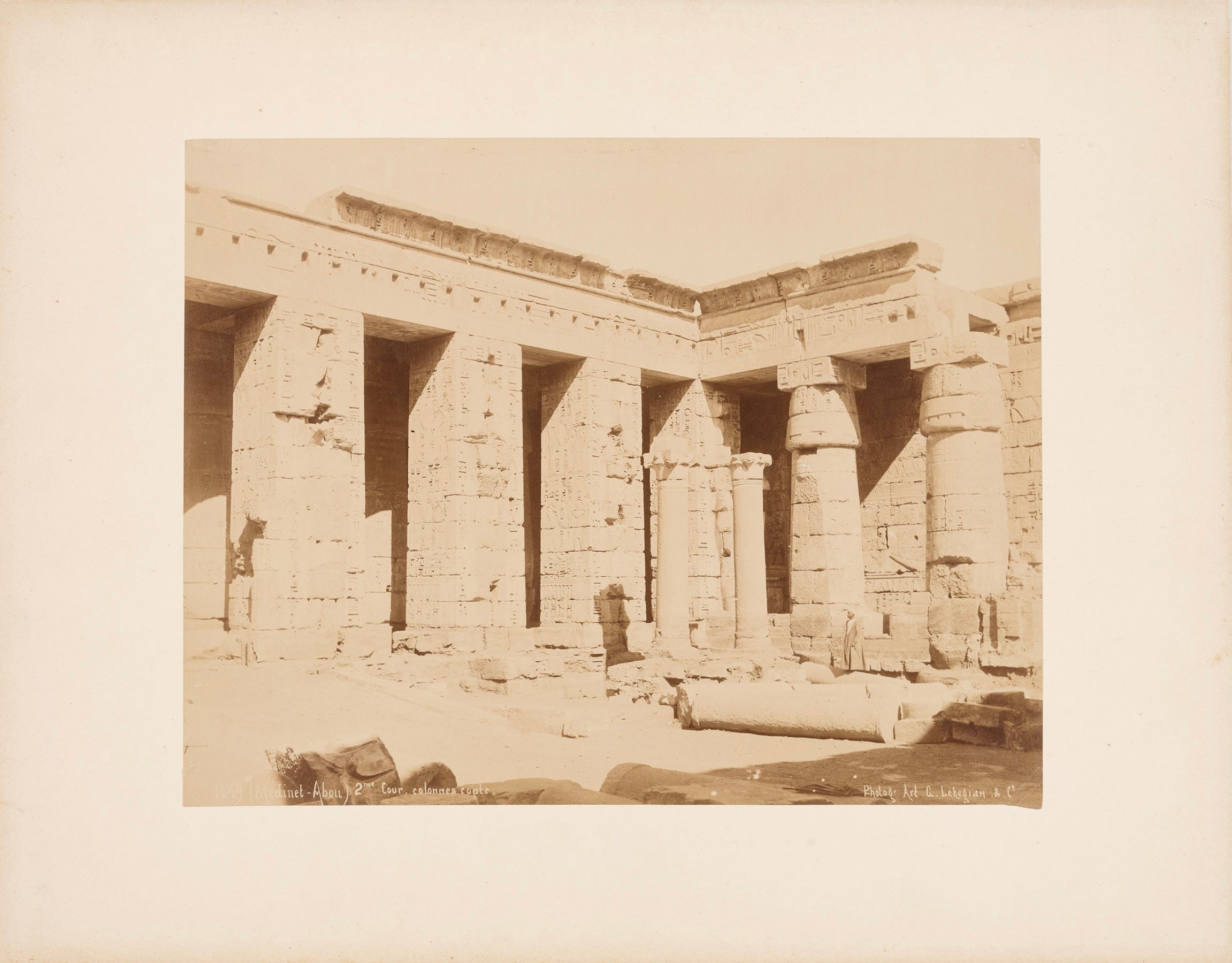
Gabriel Lekegian, (Medinet-Abou) 2me Cour, colonnes copte / Ramesses III at Medinet Habu, ca. 1880–90s. Albumen print mounted on card. (Sold unframed.)
Lekegian’s photograph of the second court at Medinet Habu concerns the great mortuary temple built for Ramesses III during the twelfth century BC. The French title preserved in the negative, (Medinet-Abou) 2me Cour, colonnes copte, directs attention to the Christian history of the site. During late antiquity, the temple complex became the centre of a substantial Coptic settlement, and parts of its courts were adapted for use as a church. The photograph therefore documents a building whose pharaonic decoration had been modified by later religious occupation.
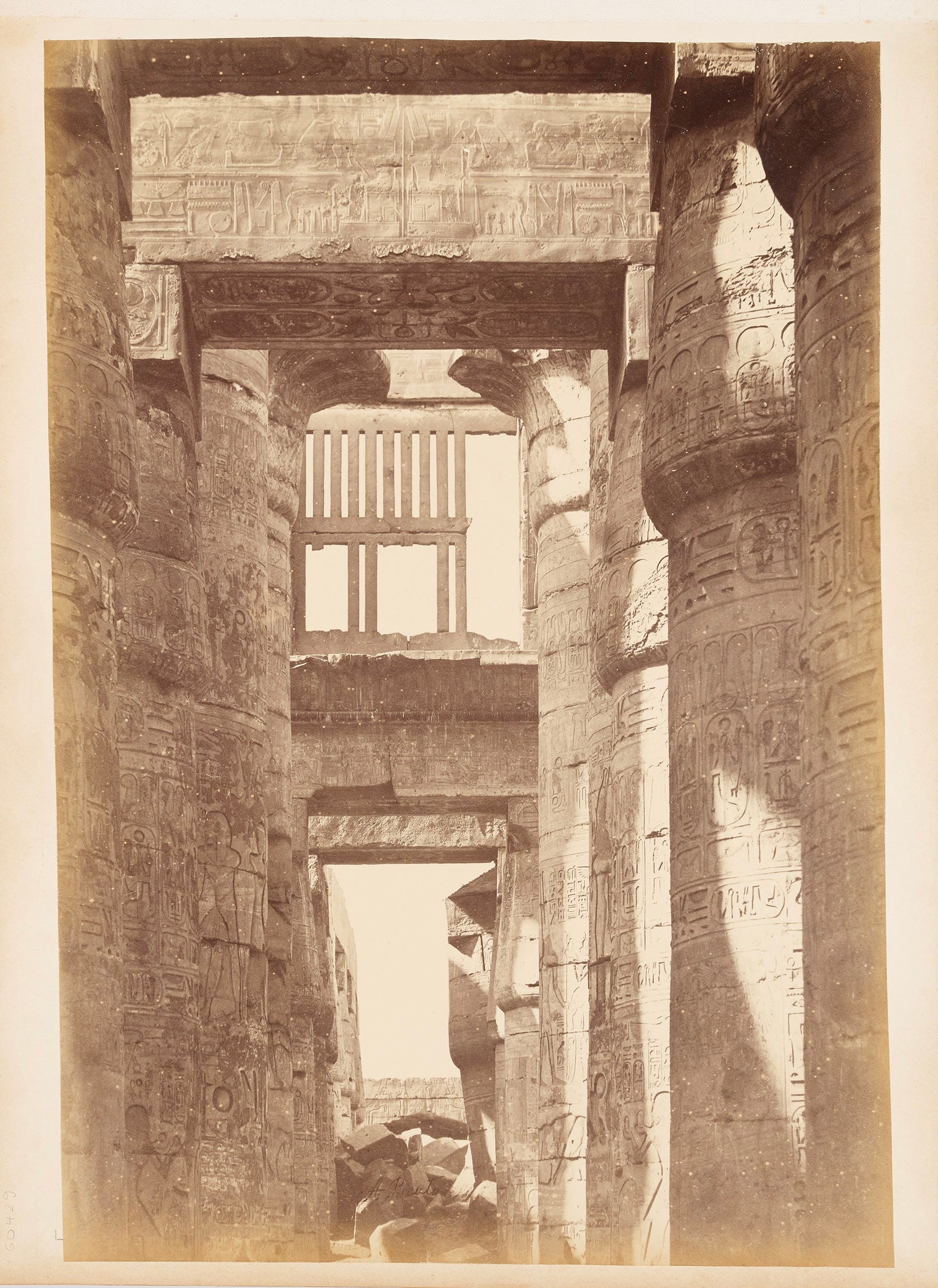
Antonio Beato (ca. 1825–1906), Two photos of the Hypostyle Hall of Karnac, interior and central isle, ca. 1870–80. Albumen print mounted on card. (Sold unframed.)
Antonio Beato established himself at Luxor during the early 1860s and remained there until his death in 1906, producing one of the most extensive photographic records of the monuments of Upper Egypt. His long residence distinguished him from photographers whose knowledge of the country was formed during a single expedition, and the location of his studio allowed him to return repeatedly to the temples around Luxor as excavation and restoration altered their appearance.
The two photographs of the Great Hypostyle Hall at Karnak address a building whose size and internal density made it exceptionally difficult to represent. Constructed principally during the reigns of Seti I and Ramesses II, the hall contains 134 columns, with the twelve columns of its central aisle rising above the surrounding supports. Beato photographed both the interior and the central aisle, using separate viewpoints to make the building intelligible. The interior view conveys the compression produced by the forest of columns, while the axial photograph clarifies the structure of the hall and the processional route through its centre.
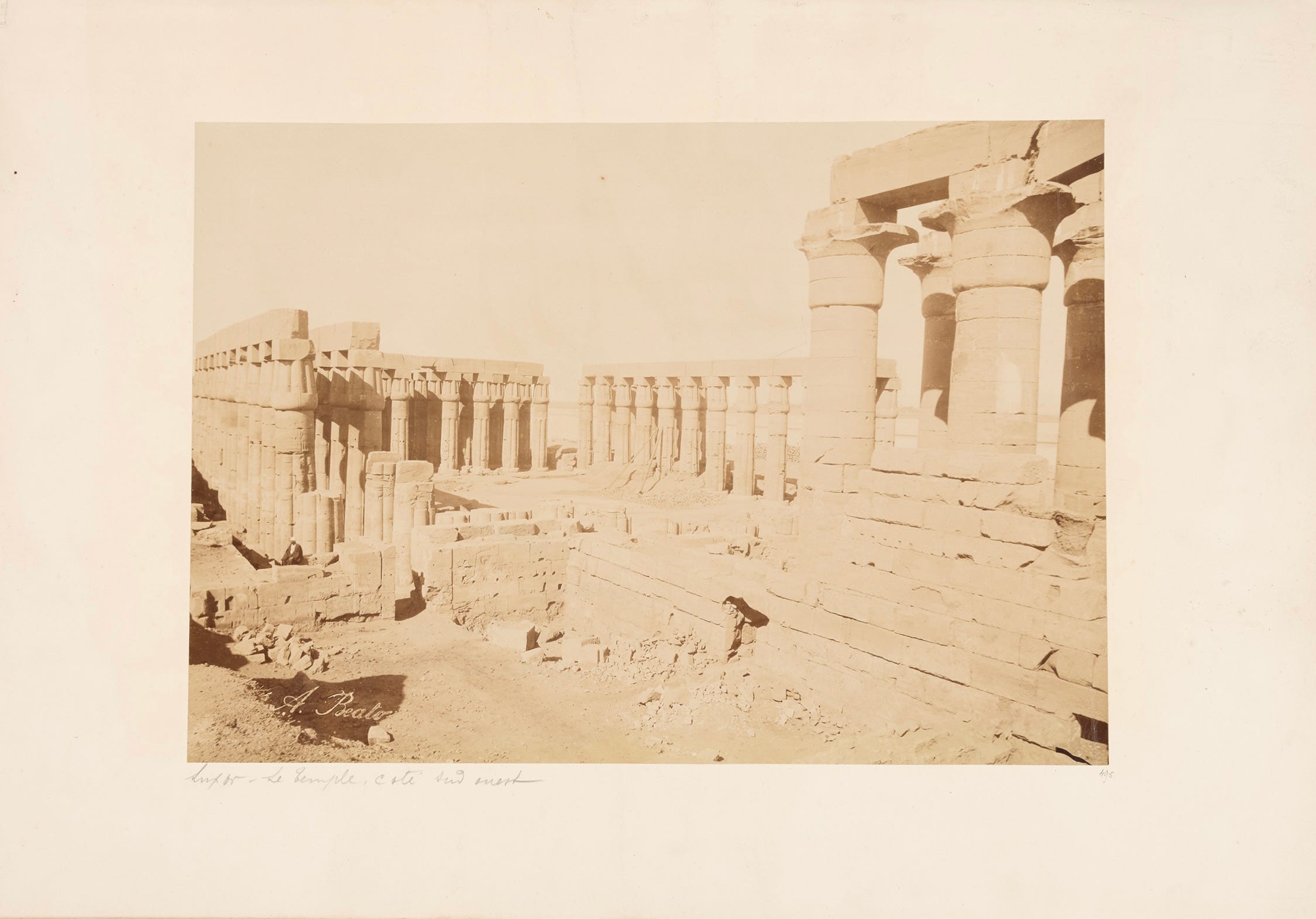
Antonio Beato (ca. 1825–1906), Luxor – Le Temple, côté [sic] sud-ouest / Temple of Amenhotep III, ca. 1870–80. Albumen print mounted on card. (Sold unframed.)
His photograph Luxor – Le Temple, côté sud-ouest, also identified with the Temple of Amenhotep III, concerns the section of the complex constructed during that pharaoh’s reign in the fourteenth century BC. Luxor Temple had, however, never belonged to a single moment. It was enlarged by Ramesses II and subsequently adapted under Roman rule, while Christian buildings and the mosque of Abu al-Haggag were later established within its precinct. Beato’s title identifies its principal eighteenth-dynasty patron, but the monument before his camera was the result of more than three thousand years of construction and reuse.
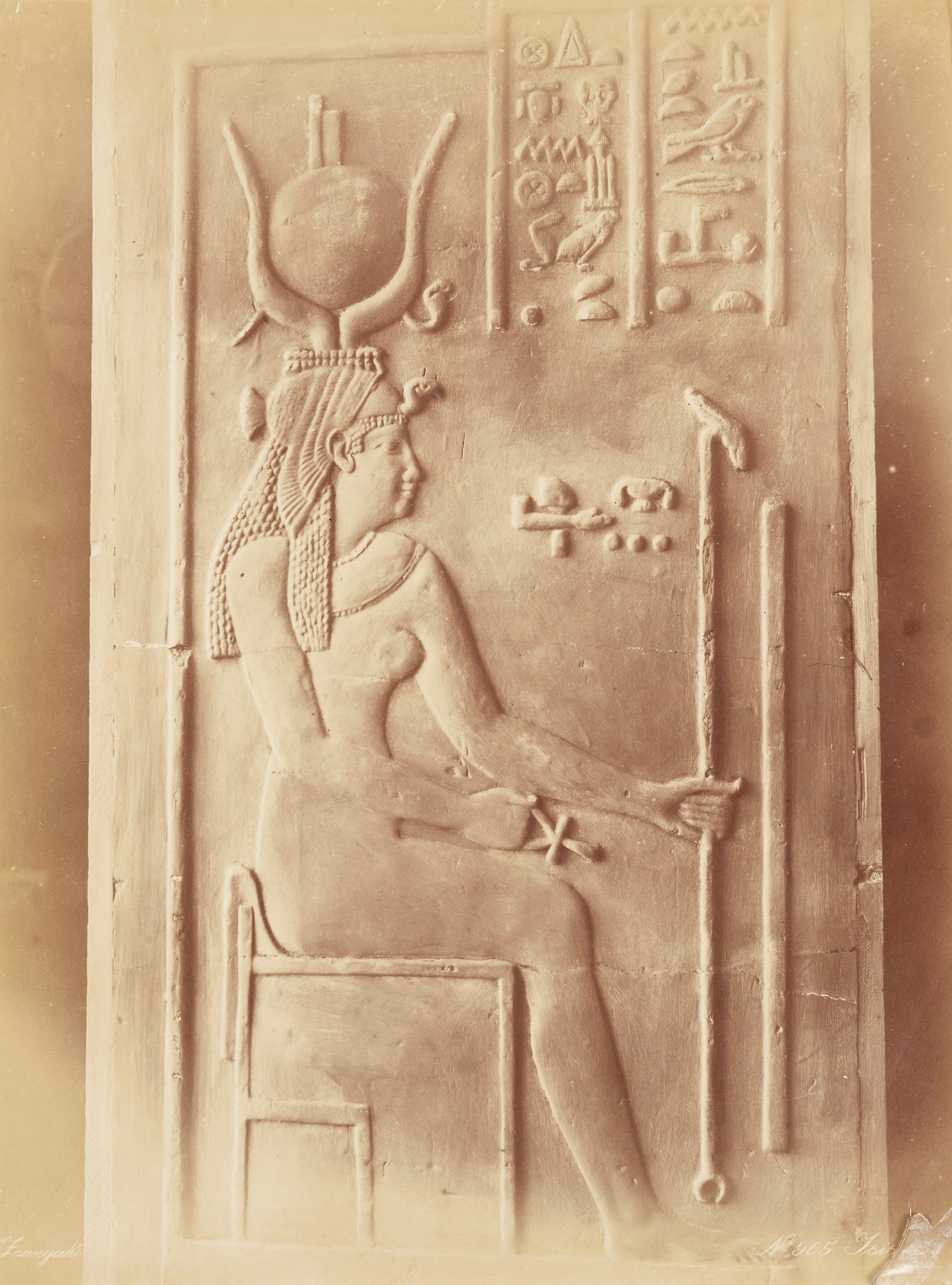
Adelphoi Zangaki (Zangaki Brothers), active 1870–1890s, Wall Relief of Cleopatra VII as Isis, ca. 1880. Albumen print. (Sold unframed.)
The biographical identities of the photographers known as the Zangaki Brothers remain uncertain, despite the large number of their images that survive. Probably of Greek origin, they worked in Egypt during the closing decades of the nineteenth century and photographed archaeological sites, the cities of the Nile and the construction of the Suez Canal. Their negatives were numbered and titled for commercial distribution, while a horse-drawn photographic van allowed plates to be prepared and developed during journeys beyond the studio.
Their photograph of a wall relief representing Cleopatra VII as Isis belongs to the renewed prominence that the queen acquired in nineteenth-century European culture. Cleopatra’s association with Isis had formed an important part of Ptolemaic royal imagery, presenting the ruler through an established Egyptian language of divine motherhood and legitimate succession. The photograph removed the relief from the architectural sequence to which it belonged and made it available as an independent image, concentrating attention upon a figure whose historical reputation had already been reshaped by classical literature and European drama.
The Zangaki Brothers worked for a market in which antiquarian interest and tourism were increasingly inseparable. Their photographs could serve as records of inscriptions and monuments, but they were also objects purchased during a journey and arranged afterwards according to the interests of their owner.
Explore the full selection of nineteenth-century photographs online, or view them at Colnaghi London as part of Out of the Sand, on view until 17 November 2026.
Old soul, young eye.
Old Masters made modern.
Colnaghi continues to celebrate the dialogue between past and present.
Visit our Website
Read our Latest Journal
Follow us on Instagram